G-scan UVSS







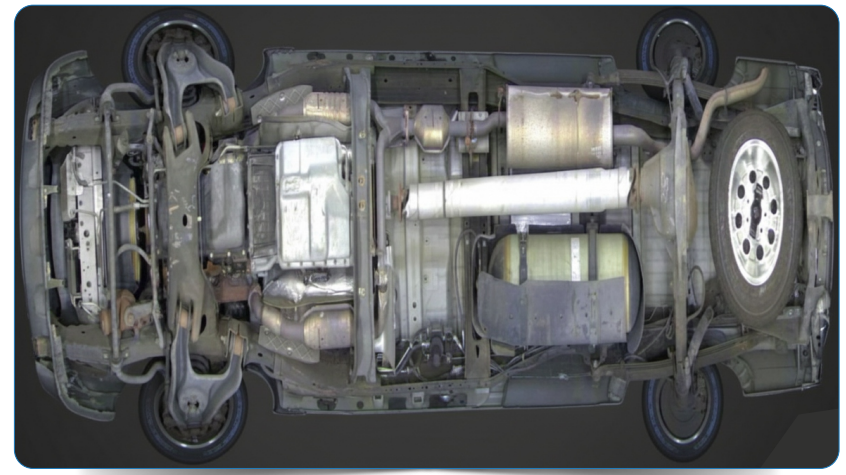
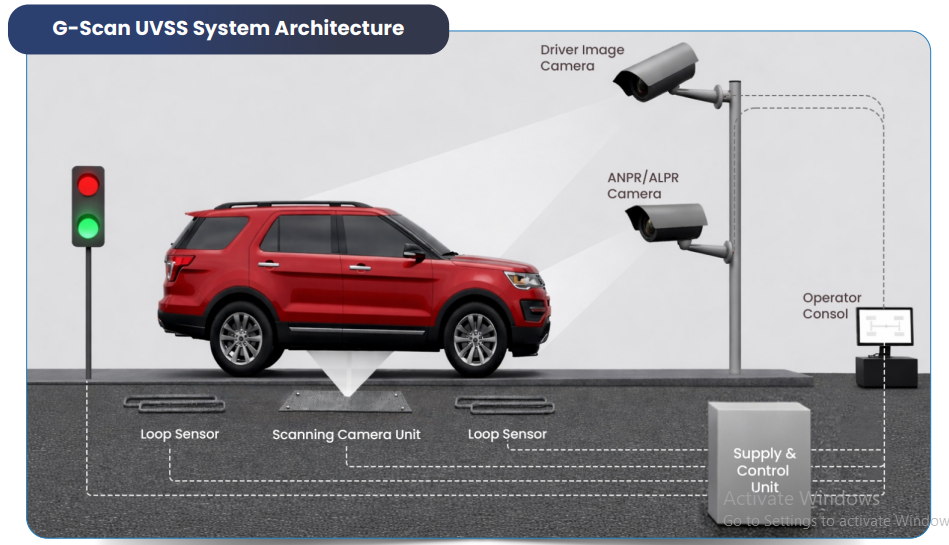
G-scan Under Vehicle Surveillance Systems (UVSS) deliver a single, high-resolution composite image of the vehicle’s undercarriage in real time using a GigE area-scan camera, without requiring the vehicle to stop. The system simultaneously displays the underbody composite image, driver photo, vehicle front image, and license plate on the monitoring screen with minimal latency.
G-scan UVSS enables fast, distortion-free inspection even in continuous traffic flow. Integrated intelligent software assists in identifying anomalies, concealed items, and threats, while all inspection data is securely archived.
By replacing traditional manual and mirror-based checks, G-scan UVSS offers a faster, more accurate, and reliable method of under-vehicle inspection, enhancing both operational efficiency and security.
High-Resolution Imaging
Advanced area-scan technology delivers clear, detailed undercarriage images.
Real-Time Vehicle Scanning
Captures complete underbody images at speeds up to 40 km/h (optimal 30 km/h).
Driver Image Capture
Automatically captures and stores number plates with recognition support up to 100 km/h (optimal 60 km/h)
Enhanced Illumination
Dual high-intensity LED arrays ensure reliable imaging in low light or harsh weather.
Certified & Reliable
CE and ISO compliant; built for continuous security operations.
Rugged Construction
Weatherproof steel chassis with stainless-steel top plate for long-term durability
Flexible Integration
Compatible with access systems like boom barriers, bollards, and tyre killers; supports enterprise databases.
Low Maintenance
Easy cleaning and servicing with convenient wash-down access.
| Parameter | G-scan UVSS |
|---|---|
| Main Scanning Camera | |
| Camera Type | GigE Area Scan camera |
| Sensor | CMOS |
| Interface Type | GigE |
| Resolution | 1920 × 1200 pixels |
| Field of View | 180 Degree |
| Power Supply | 12–24 V |
| Processing Unit | |
| Processor | Intel Core i7 or Latest |
| Memory | 16 GB RAM |
| Storage Capacity | 2 TB |
| Display | 22 inch Monitor |
| Connectivity | GigE LAN Interface |
| Operating System | Windows 10 Pro or Latest |
| Driver Imaging Camera | |
| Camera Type | IP Camera with IR LED illumination |
| Resolution | 2 MP |
| Camera Range | 8–10 meters |
| Video Format | NTSC / PAL |
| Power Supply | PoE |
| ANPR Camera Camera | |
| Camera Type | CMOS camera with motorized lens |
| Resolution | 2 MP |
| Frame Rate | 30 fps |
| Camera Range | 15 meter |
| IR Range | 60 meter |
| Power Supply | PoE |
| Parameter | G-scan UVSS |
|---|---|
| Electromechanical Assembly | |
| Overall Dimensions | 1800 × 1200 × 600* |
| Construction Material | Structural steel foundation finished with a checkered stainless-steel plate on the upper surface |
| Lighting System | LED Array (synchronized with active camera shutter) |
| Vehicle Detection | Inductive Vehicle Detection Loop Sensor |
| Software Specification | |
| Supported OS | Windows |
| Type of Plates for ANPR Camera | Recognition for English and regional fonts |
| Image Input | Image or Live Video Input |
| Zoom | Up to 64x zoom with database-supported comparison |
| Image Archiving | Stores 100,000+ records with fast retrieval |
| Intuitive GUI | Multilingual, user-friendly interface with customizable display settings |
| System Specifications | |
| Minimum Vehicle Clearance | 4.7 inches (120 mm) |
| Maximum Vehicle Coverage | Scans vehicles of all length and breadth |
| Main Power Supply | 220VAC ±10%, 50Hz |
| Power Consumption | < 0.8 kVA |
| Image Processing Time | Takes around 3–5 seconds to process a passenger vehicle |
| Load Capacity | Up to 40 tons |
| Mechanical Structure Protection Rating | IP68 |
| Storage Temperature | -20°C to +70°C |
| Operating Environment | Temperature: -10°C to +60°C, Humidity: 10–95% RH, non-condensing |
| Working Capability | Continuous 24 × 7 Operation |
Border, Customs & Transportation:
Land border check posts (ICP/LCS), customs checkpoints, airport approach roads and staff entry gates, seaports, container terminals, toll plazas, railway yards, and metro depots.
Government, Defence & Law Enforcement:
Government buildings and ministries, parliament and legislative complexes, military bases, naval dockyards, air force stations, police headquarters, intelligence facilities, embassies, and diplomatic missions.
Critical Infrastructure & Industrial Facilities:
Nuclear power plants, atomic research centres, power generation and distribution facilities, oil & gas refineries, pipelines, LNG terminals, ports, shipyards, data centres, and telecom hubs.
Public Venues, Events & VIP Security:
Stadiums, arenas, exhibition centres, political rallies, mass gatherings, VIP convoys, hotels hosting high-profile guests, and special event venues.
Commercial, Residential & Institutional Sites:
High-security corporate campuses, industrial parks, manufacturing plants, IT parks, R&D campuses, gated communities, and premium residential complexes.
Emergency & Temporary Security Deployments:
Disaster management zones, temporary checkpoints during elevated threat levels, election counting centres and strong rooms, and mobile or rapid-deployment security operations.
Correctional Institutions:
Prisons, high-security jails, detention and remand centres.